
SampleIN™ Lysis Set for PCR/qPCR - fast sample lysis to release the PCR-ready DNA
Applications
- Fast crude sample preparation for direct PCR/qPCR
- Template preparation for direct PCR/qPCR from mouse tail or ear, mammalian tissues (including FFPE), hair follicle, buccal swabs, and blood (including EDTA or FTA samples)
Benefits
- PCR-ready crude samples in 15 minutes
- Single-tube fast and efficient DNA release
- High yield PCR and efficient qPCR without tedious DNA extractions
- No material losses, minimized pipetting and hands on time
SampleIN™ Lysis Set for PCR/qPCR


Product information "SampleIN™ Lysis Set for PCR/qPCR"
SampleIN™ Lysis Set for PCR/qPCR is a combination of a lysis buffer and protease-containing buffer allowing for a fast lysis of different sample material to release the DNA in a short time.
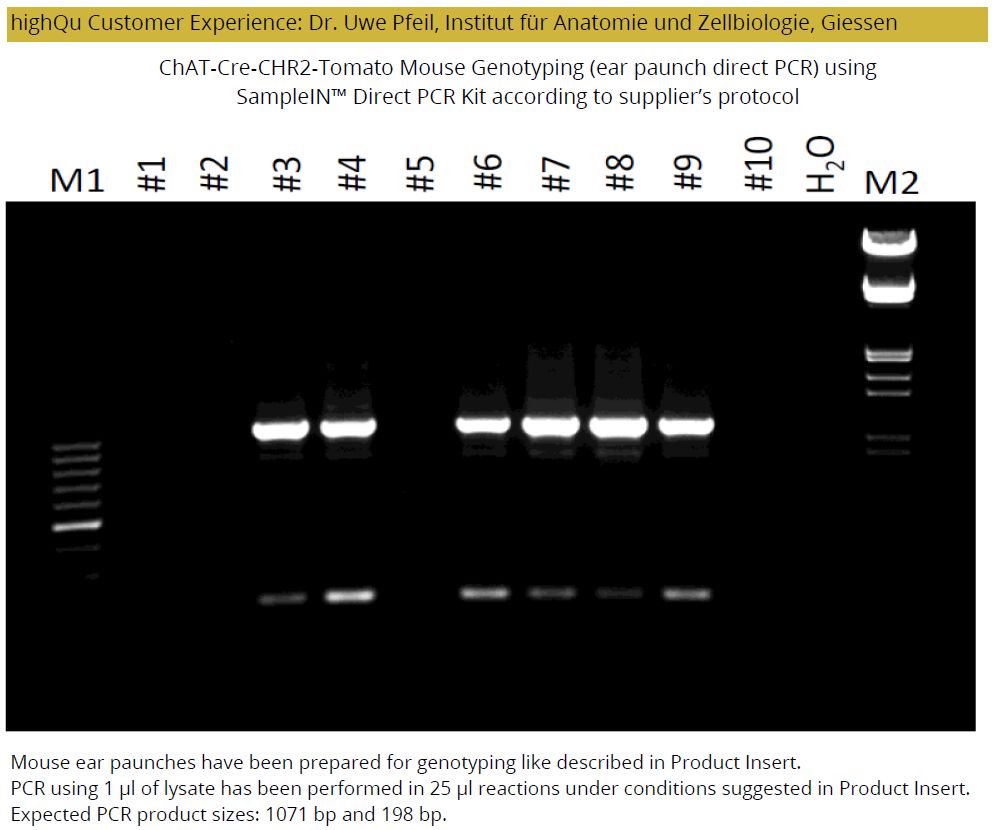
SampleIN™ Lysis Set for PCR/qPCR is a part of our SampleIN™ Direct PCR Kit. SampleIN™ Direct PCR Kit includes two modules: Two Lysis/Protease Buffers (Lysis Set for PCR/qPCR) and Hot Start PCR Master Mix.
The quickly lysed samples contain enough DNA for PCR and qPCR/RT-qPCR applications, eliminating the need of tedious template purification. The set is used to prepare templates for direct PCR or qPCR from mouse tail or ear, mammalian tissues, hair follicle, buccal swabs and blood. It can also be used with some plant materials, if these are not considered as very oily, hard or difficult to lyse.
Rapid 15 min DNA extraction using DPK Lysis and Protease Buffers in a single tube generates crude PCR template extract which can be further amplified using inhibitor resistant, robust PCR or qPCR mixes such as ALLin™ HS Red Taq Mastermix, or SampleIN™ qPCR Probe Mixes.
More information:
How to perform direct or crude sample PCR, qPCR and RT-qPCR
Using clinical or environmental samples without nucleic acids extraction.
Why direct PCR is not always working?
Quantitative PCR (qPCR) and reverse transcription qPCR (RT-qPCR) are fast techniques enabling detection and quantification of pathogens and nucleic acids. Direct amplification from crude samples avoids tedious extraction, but crude samples often contain natural PCR inhibitors that reduce efficiency, yield and reproducibility.
Short sample lysis combined with a swift protease digestion (for example using highQu SampleIN™ Lysis Set for PCR/qPCR) generates PCR/qPCR-ready templates. Crude extracts can be refrigerated and used for days to weeks.
Common PCR inhibitors in environmental & clinical crude samples
| Sample Type | Common Inhibitors |
|---|---|
| Blood | Hemoglobin, lactoferrin, immunoglobulins; heparin (anticoagulant) |
| Urine | Urea, salts, organic acids |
| Buccal swabs / Saliva | Mucins, proteases, food residues (polysaccharides, fats) |
| Plants | Polyphenols, polysaccharides (pectin), secondary metabolites, humic acids, seed lipids |
| Soil | Humic/fulvic acids, metal ions, polysaccharides, polyphenols |
Inhibition minimization & direct PCR optimization (brief)
- Use robust, inhibitor-resistant PCR/qPCR mixes that contain inhibitor-reducing and PCR-enhancing agents.
- If direct PCR fails without lysis, perform dilution series (e.g. 1:10 and 1:100). Rule of thumb: less is better than more.
- Always run positive controls with different dilutions of crude extract to determine at which concentration inhibitors appear.
- If direct PCR fails, perform lysis per kit manual and repeat dilution series. Optimize lysis and PCR parameters.
General rapid lysis procedure (highQu SampleIN™ Lysis Set for PCR/qPCR)
1. Sample collection & guidelines
| Sample (fresh or frozen) | Amount | Extraction vol. |
|---|---|---|
| Mouse tail | 2 mm or 3–5 mg | 100 µl |
| Mouse ear | 2 mm² or 3–5 mg | 100 µl |
| Mammalian tissue | 5 mg | 100 µl |
| FFPE tissue | 2 mm² of a 10 µm section | 100 µl |
| Blood (fresh / EDTA) | 2 µl | 100 µl |
| Blood Guthrie / FTA cards | 2 mm² | 100 µl |
| Hair follicle | 2 follicles | 100 µl |
| Buccal swab | 1 swab | 300 µl |
| Plant leaf | 2 mm², well crushed | 100 µl |
| Plant seed | Very small seed or 2 mm² piece, crushed | 100 µl |
Note: Increasing sample amounts slightly can improve yield but too much material may cause inefficient lysis and inhibition. Plant materials often require thorough mechanical disruption; optimization recommended.
2. Sample DNA lysis protocol (example)
- Use contamination-prevention measures: clean bench, gloves, sterile tubes.
- Thaw DPK buffers at room temperature and mix well.
- Prepare a 100 µl extraction reaction (use 3× volumes for buccal swabs):
DPK Lysis Buffer, 5× 20 µl DPK Protease Buffer, 10× 10 µl PCR water (not supplied) 70 µl - Mix gently. Place in thermal block / water bath:
Lysis: 75 °C — 5 min (vortex twice during lysis).
Protease inactivation: 95 °C — 10 min. - Add 900 µl PCR water. Centrifuge 1 min to pellet debris. Transfer supernatant to a sterile tube and keep on ice.
- Store at −20 °C for months or use immediately. Best results if PCR/qPCR performed immediately. Use supernatant directly as template (dilute 1:10 or more).
3. qPCR reaction setup (example)
Typical qPCR (20 µL total):
| Component | Final concentration / Notes |
|---|---|
| 4× qPCR master mix | 1× — use inhibitor-tolerant formulations |
| Forward primer | 200–400 nM (optimize) |
| Reverse primer | 200–400 nM |
| Probe (if used) | 100–250 nM |
| Template (crude lysate) | Typically 1–2 µl (test serial dilutions 1:10, 1:100) |
Controls setup
- No Template Control (NTC): detects contamination — replace template with water.
- No Reverse Transcriptase Control (−RT): for RNA templates — detects genomic DNA.
- Positive control: known pure template (purified or synthetic) to validate efficiency.
- Dilution control: test 1:10 and 1:100 template dilutions in duplicates/triplicates to reveal inhibitory effects.
- Internal Amplification Control (IAC): add a non-competitive synthetic target to detect inhibition and determine the concentration where inhibition occurs.
Template dilution advice
Start testing dilutions: 1:1, 1:10 and 1:100. Choose the lowest dilution that still gives robust amplification with acceptable Cq values. In RT-qPCR, avoid over-dilution that reduces sensitivity.
How to maintain PCR yield & reproducibility
- Keep the same optimized reaction setup and reagents (even same water) once established.
- Run reactions in duplicates or triplicates to reduce pipetting variance.
- Mix reagents well before use and maintain consistent sample input across replicates.
- Standardize lysis & dilution procedures. Avoid repeated freeze-thaw cycles — store crude extracts at +4 °C for short-term use.
Direct PCR/qPCR troubleshooting (quick guide)
| Issue | Possible cause | Solution |
|---|---|---|
| No amplification | Strong inhibition or suboptimal cycling | Increase dilution, re-lyse using less material; run annealing temperature gradient. |
| High Cq / weak signal | Low template or partial inhibition | Increase template input or prolong lysis to enrich targets. |
| Variable replicates | Pipetting error or non-homogeneous sample | Mix thoroughly, use master mixes, check plate/seal quality. |
| Amplification in NTC | Contamination | Replace reagents, clean workspace, use filtered tips. |
| Low efficiency (<85%) | Inhibitors or poor primer design | Optimize primers, increase dilution, or re-lyse with less sample material. |
| RNA degradation (RT-qPCR) | RNases in sample | Add RNase inhibitor before lysis, keep samples cold, shorten handling time, perform PCR immediately. |
```
- Download Protocol and Specifications - Product Insert SampleIN™ Lysis Set for PCR/qPCR
- Ask for a Sample today
- Have technical questions? Contact us
- Download a list of Publications mentioning highQu products
- Or see how others use our products at bioz.com or google scholar
- Download Protocol and Specifications - Product Insert SampleIN™ Lysis Set for PCR/qPCR
- Download MSDS SampleIN™ Lysis Set for PCR/qPCR
- Need a lot-specific Certificate of Analysis? E-mail us at info@highQu.com
- Want custom formulations or bulk sizes? E-mail us at info@highQu.com, and check our OEM offers
- Have more specific questions? Contact us
- Download Protocol and Specifications - Product Insert SampleIN™ Lysis Set for PCR/qPCR
- Download MSDS SampleIN™ Lysis Set for PCR/qPCR
- Download highQu Catalogue of Premium Research Tools
- Download a list of Publications mentioning highQu products
- Or see how others use our products at bioz.com or google scholar
- Download Product Pricelist
- Download all highQu Product Inserts and MSDS sheets
- Have questions? Contact us
Related Products

StainIN™ GREEN Nucleic Acid Stain is a significantly safer alternative to ethidium bromide. It is same easy to use, 4X as sensitive (under Blue LED) and much more secure. More economical as other green dyes, this stain can be also used and disposed with less environmental and health concerns compared to ethidium bromide. It is a fluorescent dye that allows detection of >0,1 ng of DNA in both agarose and polyacrylamide gels. It binds to both dsDNA, ssDNA and RNA and emits green fluorescence when bound to DNA and red fluorescence when bound to RNA detectable under the UV or Blue light and documented with same filters as similar green dyes. StainIN™ GREEN is ideal for DNA extraction from gels for cloning. Smaller than ethidium bromide carcinogenicity has been proved by Ames-test. Mammalian cell mutagenicity tests, both mouse marrow erythrocyte micronucleus and spermatocyte chromosomal aberration tests gave negative mutagenicity results. Carcinogenicity and toxicity of the widely used Ethidium Bromide (EtBr) is one of the biggest safety and environmental problems in the labs where gel electrophoresis is a daily routine. The less toxic nucleic acid dyes address this problem and minimize concerns. The StainIN™ GREEN (SYBR Green-like stains alternative), (SYBR® Green is a registered trade mark of Molecular Probes Inc.) and StainIN™ eco-RED Nucleic Acid Stains by highQu provide a much less-carcinogenic, significantly safer alternative to EtBr while delivering even several times higher detection sensitivity. Same like EtBr, these stains are used during the process of electrophoresis in an agarose gel or PAAG and in the electrophoresis running buffer. Nucleic acid stains are typically divided into two groups – they are either intercalating dyes or minor groove binders. The StainIN™ GREEN and StainIN™ eco-RED Nucleic Acid Stains belong to the group of intercalating dyes that bind to NA and produce the fluorescence signal. Same like many other suppliers of similar products, highQu retains the right to keep the precise chemical information undisclosed and proprietary. The StainIN™ GREEN Nucleic Acid Stain as well as the StainIN™ eco-RED Nucleic Acid Stain are both supplied in water. Detailed safety information is available in MSDS sheets of the stains. Despite proven less mutagenicity, all nucleic acid stains, including SYBR® Green or other shall be handled with care. Used electrophoresis buffer with a stain as well as melted gels shall be run through approved (carbon) filters. If the absence of residual fluorescence is confirmed, the liquids can be disposed with plenty of water down the drain. Alternatively, all used liquids can be autoclaved as the StainIN™ GREEN and StainIN™ eco-RED Nucleic Acid Stains degrade during the long exposure to above 100ºC temperature. The safety office shall be consulted periodically to match local regulations, as they vary and change.

highQu ALLin™ Hot Start Taq DNA Polymerase is the superior sensitive enzyme. The activity at room temperature is blocked by small molecular inhibitor. Enzyme becomes active only after heating what allows for highly specific and extremely sensitive amplification, no primer dimer formation and no background. In combination with the optimized ALLin™ buffer enzyme provides higher success rates in demanding PCR applications like amplification of crude, complex or longer templates and fast cycling. ALLin™ Hot Start Taq DNA Polymerase has the same PCR accuracy like Taq DNA Polymerase, 4.5 x 10^4 (nucleotides incorporated before the error occurs) and produces A-tailed products suitable for ligating into TA cloning vectors. The convenience of ALLin™ Hot Start Taq DNA Polymerase is maximized by the use of 2X Red colored Mastermix providing the additional advantage of reduced pipetting and minimized errors. The mastermix is even supplied with PCR Water, and the only thing to add is the template with primers. ALLin™ HS Red Taq Mastermix, 2X is premixed with red dye and density reagents for direct loading on the gels after the PCR. In a 2% agarose TAE gel the dye migrates with~350 bp DNA, in 1% agarose TAE gel with ~ 600 bp DNA fragments. ALLin™ HS Red Taq Mastermix, 2X is also a key component in highQu SampleIN™ Direct PCR Kit (DPK0101/5), ensuring outstanding PCR results with crude samples.

highQu ready to use DNA ladders are mixtures of highly purified plasmid digests and PCR products. The high ladder purity allows for exceptional stability and room temperature storage. Ladders are ready to be directly loaded on agarose gels and are supplied with the loading dye solution for probe DNA. They provide sharp bands for DNA sizing and allow for approximate DNA quantification by comparing the amount of DNA of the band similar in size to your sample band.

highQu dNTP sets and mixes meet all highest industry standards and allow for unrivaled performance of your PCR and other DNA synthesis, labeling or sequencing reactions. Produced under the stringent quality monitoring conditions, they guaranty reproducible results. More than 99% HPLC purity eliminates inhibitions of PCR and allows for increased yields with higher dNTP concentrations. Exceptional stability of dNTPs allows for short term ambient temperature shipments, short term room temperature storage or long PCR of more than 30 kb targets, as well as long amplifications exceeding 40 cycles.